



Deploy performance-tuned models on Day 0Ready to use, built for productionUnified support for heterogeneous AI chipsContinuously improving performance

ModelSphereOpen source platform for production deployment and inference optimization

Take LLM inference from a working prototype to reliable production, and turn every GPU into an efficient token factory.

Built on Kubernetes, ModelSphere brings model deployment, cache-aware routing, SLO-based autoscaling, comprehensive observability, recovery from hangs within seconds and the Tuning Agent feedback loop together in a production-grade inference scheduling system that reliably handles large-scale traffic on heterogeneous hardware.

Applications

  • Claude
  • Codex
  • OpenClaw
  • Enterprise knowledge base
  • Business agents

Standard API access

ModelSphere

Open source platform for production deployment and inference optimization

  • Model deployment & tuning
  • Cache-aware request routing
  • Dynamic rate limiting
  • Prefill/Decode separation
  • Three-tier KV cache
  • Quality-based autoscaling
  • Automatic stream resumption
  • Tuning Agent optimization

Unified deployment & service management

Integrated inference engines

  • vLLM
  • SGLang
  • More engines

Hardware resource management & scheduling

AI accelerators

  • Huawei Ascend
  • Iluvatar
  • Moore Threads
  • Hygon
  • NVIDIA
  • More AI chips

Architectural Pillars

Four core technologies for production LLMs

Built for production engineering. ModelSphere combines advances in research with experience operating large-scale services in a standardized platform.

Zero-Day Ready

Keep pace with the model ecosystem through our inference optimization community, adapting and tuning new models for rapid import, configuration, and production deployment.

Day-one model certification100% official compatibility
DeepSeek-V4-ProDeepSeek-V4-Flash-0731Qwen3.8-2.4T-A95BKimi-K3MiniMax-M3GLM-5.3-Flash
Set up an AI inference platform for production in minutes, with model serving, scheduling, autoscaling, observability, and operations built in. Manage your cluster through a unified Web UI without complex low-level tuning.

AutoscalingENABLED: 4-32 Pods
Dynamic rate limiting based on service qualityTTFT < 10s, OPTS > 20

ModelSphere runs across heterogeneous AI hardware through one platform. It natively supports general-purpose GPUs and uses EngineX to integrate Huawei Ascend, Iluvatar CoreX, Moore Threads, and Hygon accelerators, bringing mixed-hardware nodes under unified management.

Huawei AscendIluvatar CoreXMoore ThreadsHygon DCU...
Tuning Agent Inside

ModelSphere continuously integrates new inference optimizations. Built-in Tuning Agent adapts configurations to your models, hardware, and production workloads to improve latency, throughput, and resource efficiency.

Relative throughput (optimized = 100%)About 285% above baseline
Baseline capacity26%
Optimized capacity100% capacity
Day-0 Deployment

Deploy performance-tuned models on Day 0

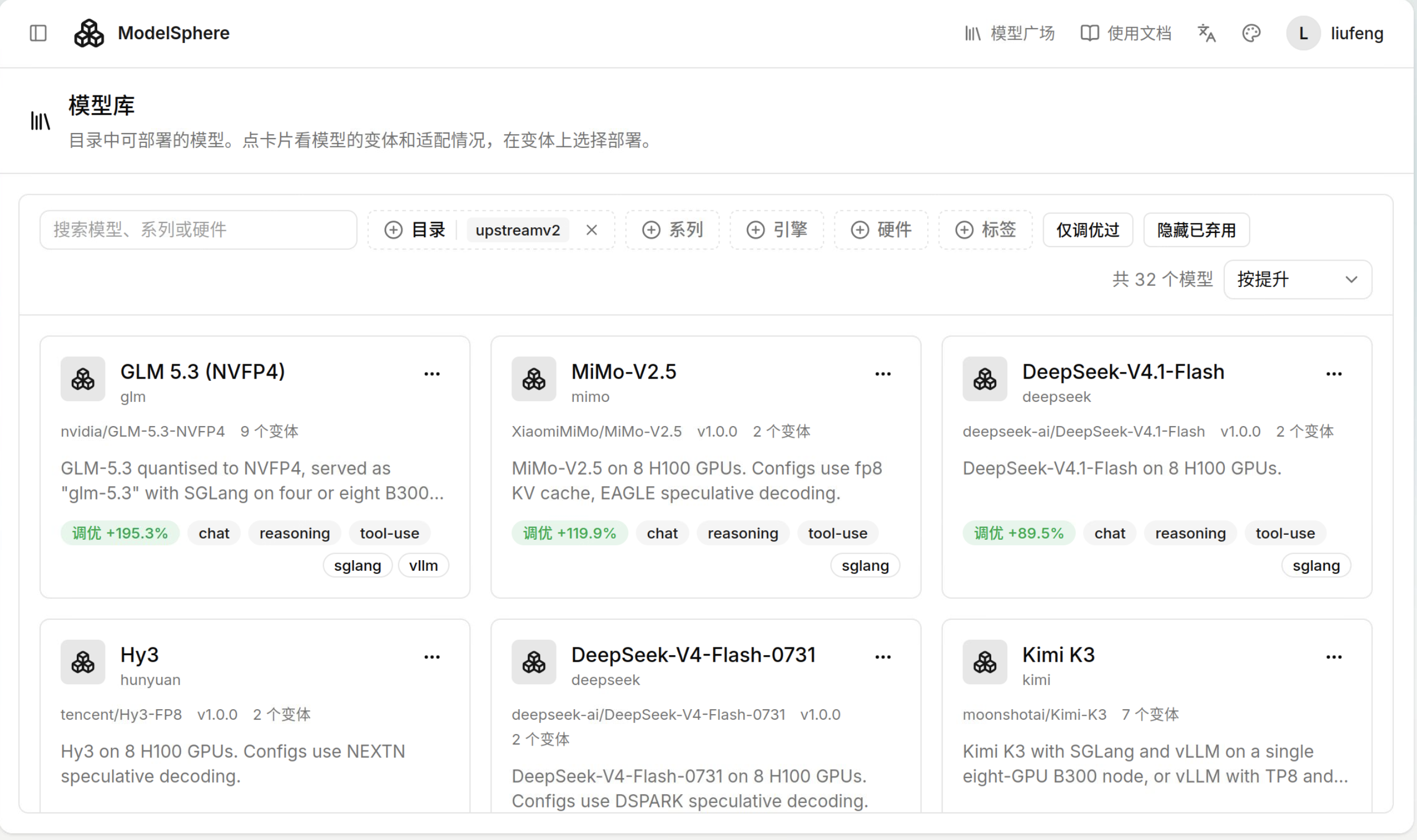
Choose a model and deployment variant in the model catalog, then deploy a tuned configuration with one click.

ModelSphere Console model library: sorted by improvement, browse models, deployment variants, and tuning gains.
Cluster-wide service quality protection

Stream resumption:Uninterrupted answers when a machine hangs or crashes

Use the resources of the entire compute cluster to protect model service quality for every user. No need to ask again, no error interruptions.

Detect anomalies immediately

Millisecond heartbeat detection proactively prevents single-GPU cascading failures

Millisecond detection

Automatically switch to another cluster machine

Health-aware topology scheduling moves requests to idle nodes in seconds

Seamless load optimization

Continue the existing answer

Synchronize and migrate cached history for a coherent continuation

No repeated tokens
Invisible to end users100% protection from service interruptions caused by single-machine failures
AI chatConnected · Responding in real time
Seamless for users

Please analyze the core principles and best practices for building enterprise LLM compute clusters in 2025.

DeepSeekDistributed cluster inference
Throughput: 64.2 tokens/s
Answered by cluster machine A (initial route)Generation progress 45%

The foremost principle of LLM cluster construction is [high throughput and disaster resilience]. In production under high concurrency, individual-node memory fluctuations, momentary network failures, or hardware hangs are inevitable.

Automatic background handover complete(Switch time <18ms · 0 lost tokens)
Cluster machine B continues the previous machine’s answerGeneration complete 100%

The system must therefore support intelligent live context migration, automatically allocating healthy compute to continue the analysis without client retries, protecting core production workloads from hardware instability.

Stream resumption technology

Cluster background handover in seconds
Real-time handover available
  1. 1
    Machine A

    Responding to the request

    Load 42%Healthy
  2. 2
    Machine A

    Unexpected failure / hang

    Circuit breaker triggeredHardware interruption
  3. 3
    Machine B

    Scheduled takeover in seconds

    Latency <18msZero loss
  4. 4
    Machine B

    Continue streaming the answer

    Output restored100% coherent
Adaptive global throughput and SLO assurance

ModelSphere Dynamic rate limiting: maximize compute utilization while maintaining service quality

Keep every model service on the platform meeting expected service quality, including response speed, generation fluency and consistently low jitter

Traditional static mode

Traditional static rate limiting

Hard thresholds based on fixed request counts or limits

Concurrency limit
Simple requests(spare compute capacity)
Complex requests(prone to slowdowns)

Fixed thresholds cannot sense actual compute load, leaving capacity either idle or overloaded.

Core challenges

Why is static rate limiting hard to get right?

LLM compute demand fluctuates nonlinearly

Requests vary greatly

Everyday Q&A and 32k+ code analysis can differ by tens of times in memory usage, KV cache and duration.

Capacity changes in real time

Time-varying topology

Continuous batching, attention matrix utilization and node network load all affect processing capacity dynamically.

Traditional APM metrics cannot serve as a basis for static thresholds in Transformer architectures.

AI adaptive scheduling core

ModelSphere dynamic rate limiting

Sense hardware load and adjust concurrency thresholds in milliseconds

Concurrency / CapacityReal-time adaptive tracking
Spare capacity: raise the limit (98% utilization)Rising latency: tighten the limit for protection

Concurrency limit adjusts to SLO in real time

Time window: 50ms sampling interval

An elastic concurrency ceiling that wastes no GPU cycles.

Higher utilization

Automatically admit more traffic when compute is available, eliminate idle gaps and maximize output from high-performance resources.

A more stable experience

Millisecond backoff protects against peak traffic and long tasks, preventing cascading overload while stabilizing time to first token (TTFT) and token generation speed.

Lower operational costs

No manual labeling

Replace repeated manual load tests and parameter tuning with automatic adaptation to throughput baselines across colocated models.

Smart compute scheduling · Eliminate idle resources

Dynamic compute scaling:
Allocate to model traffic in real time
Keep compute fully utilized, 24/7

Overcome the limits of binding models to fixed compute: wasted resources off-peak and insufficient capacity at peak demand.

Measure model usage in real time

Scale compute automatically with traffic

Eliminate waste from idle compute

Keep popular models responsiveZero idle compute resources
Traditional fixed allocation

Large amounts of compute sit idle off-peak

ModelSphere dynamic allocation

Compute follows traffic, keeping the cluster 100% utilized

GLM 5.3Office / analysisMiniMax M3Code / batch processing

Cluster compute pool: 10 fixed GPUs, seamlessly reallocated in real time

24-hour workload distribution (combined share = 100%)Dynamic compute utilization: 100%
GLM 5.3 compute allocation ↑MiniMax M3 compute allocation ↓
00:0009:00 (blue 80% : purple 20%)15:00 (blue 60% : purple 40%)23:00 (blue 20% : purple 80%)24:00

Daytime peak 09:00

High office workload traffic

GLM 80% (8 GPUs)MiniMax 20% (2 GPUs)
01
02
03
04
05
06
07
08
09
10
Sense demand
and reallocate

Regular hours 15:00

Balanced traffic

GLM 60% (6 GPUs)MiniMax 40% (4 GPUs)
01
02
03
04
05
06
07
08
09
10
Auto
scaling

Nighttime peak 23:00

High nighttime task traffic

GLM 20% (2 GPUs)MiniMax 80% (8 GPUs)
01
02
03
04
05
06
07
08
09
10

Compute scales with model traffic in real time, with the combined allocation always at 100%, eliminating idle compute

CORE MECHANISM 03 · CONTINUOUS SELF-EVOLUTION

Tuning Agent continuous optimization

ModelSphere connects real production traffic, idle off-peak compute, hyperparameter grid search, and zero-downtime canary releases in an automated optimization loop, reducing manual trial-and-error benchmarking.

A new optimization approach

From manual experiments to continuous improvement

Use idle compute to unlock hardware potential and make inference faster over time.

Better sampling

Static test datasets → Real traffic features from a 7-day sliding window

Lower cost

Benchmarks consuming production resources → Concurrent grid search on idle off-peak compute

Safer delivery

Restarting services to update parameters → Automatically validate the best configuration and hot-load it in production without downtime

1Production inference
Stable operation

Reliable, low-latency, highly available service

NODE-01
NODE-02
NODE-03
5Automated rollout
Canary rollout

Deploy the best configuration with seamless hot reload

Config Push100%
Rolling Deploy

Continuous optimization loop

TUNING AGENT
2Collect traffic data
Traffic feature collection

Build sliding-window datasets and prefix topology

Window7 Days
Prompt Profiler
4Generate and validate configurations
Real workloads

Select the best inference configuration using real workloads

★
+48.6%SLO P99<200ms
3Tune with idle compute
Off-peak search

Search inference hyperparameters in parallel during off-peak hours

02:00~06:00Night Tuning
Chunk/TP18 Sets
Production Ready Infrastructure

Ready to accelerate your LLM inference cluster?

Explore the open source code and build the next generation of inference infrastructure with AI engineers.